According to
Uncle Earl Wayne
By
Bonnie Wayne McGuire
(The following story was
told to me many years ago)
Your
dad and I had very fascinating experiences during our life. You
perhaps know that your grandfather was quite an individual. He did
much to develop the western part of the United States. Although your
father and I were quite young, we did travel quite a bit as a result
of our father's vocation. It required us to move frequently and we
lived in every city in California of any size and consequence,
Arizona, New Mexico and northern Mexico....particularly out in the
Sonora country. Likewise, we lived in the eastern part of the United
states, in Pennsylvania and Michigan. Because my father was in the
mining business we moved accordingly.
I do not have too many of the details of our
life as youngsters, except I can tell you a little bit about your
grandfather from what he told both your father and myself. He left
Pennsylvania as a young boy. He was born on a ranch, shared with
nine sisters and two brothers. He was next to the youngest member of
the family. When he was around eighteen years old he left home. He
didn't like the farming environment so went to Michigan where he
worked in the mines and became quite adapted to it. The iron mines
etc.
Then he decided to go west....traveling
through the Dakota's where he discovered there wasn't much going on
in those days, although later on they developed big mines. He and
another man then went to Great Falls, Montana where they filed a
claim. That claim today would be in the center of the city of Great
Falls. Things didn't work out too well for them, so they moved on to
Butte where they were studying and planning to develop big copper
mines. Your grandfather had the job of sinking the main shaft in
this big mine in Butte.
While he was in the process of doing this he
fell down the shaft and broke his back and legs, and was forced to
spend a year in the hospital. He was a large man around six foot
four or five inches tall, and never weighed less than 250 pounds
even as a young fellow. He weighed about 300 pounds when we knew
him. Neither one of us took after him in that respect...
The doctors told him he'd never walk again,
but he was a very industrious man with a lot of will power. When he
left the hospital he was determined to walk. He got a job in a mine
working with a small bit and hammer. he'd crawl into the mine where
he worked hard. Finally his power began to come back, and his legs
functioned normally.
Then he went back to Butte where they were
still in the process of digging the big shaft. He became foreman
first, but they weren't making any progress. Then he became
superintendent responsible for sinking the shaft...which he did. He
accomplished something that had never been done before....a four
compartment shaft. He became quite famous as a result of this, and
became associated with Senator Clark and others promoting mines
during the early day development of Montana. senator Clark was quite
a character. They were all individuals and rough characters. Very
powerful in their thinking and ways.
Your grandfather, meanwhile, had married and
had a son and daughter during his years in Montana. Eventually he
left Montana, because he couldn't stay in one place too long. I
can't justify him for leaving his family behind, but he moved on to
Virginia City.
He met your grandmother on the Narrow Gauge
train as she was traveling to Virginia City (from Grass Valley) with
her family. She was a young girl weighing about eighty-nine pounds
in those days, and had beautiful red hair. He became quite taken
with her, and they decided to marry not long after that. He was
running for representative of the state at that time, and doing mine
work also.
Anyway, they got married. He came to Grass
Valley because her family was there....and decided to go to San
Francisco on their honeymoon. But they had to take the Henwood
family and Trezise family along.
The marriage announcement came out in the
papers and shortly afterwards they discovered that your grandfather
hadn't received his final decree of divorce from his wife in
Montana. It caused quite a scandal in Grass Valley, because he was a
prominent mining expert well known by Billy Bourne and others in his
profession. he didn't spend much time in Grass Valley because he
couldn't stand the narrow-mindedness.
Anyway, when his divorce became final he and
your grandmother remarried and moved to San Francisco where he was
probably promoting something. Then they left San Francisco and sent
her family back to Grass Valley.
They settled in Arizona where he was
developing several big mines. Someday I'll show you the newspaper
that published quite a story on what he was doing. He also was
developing a mine in Mexico, around Cananea I think, where some
interesting stories developed.
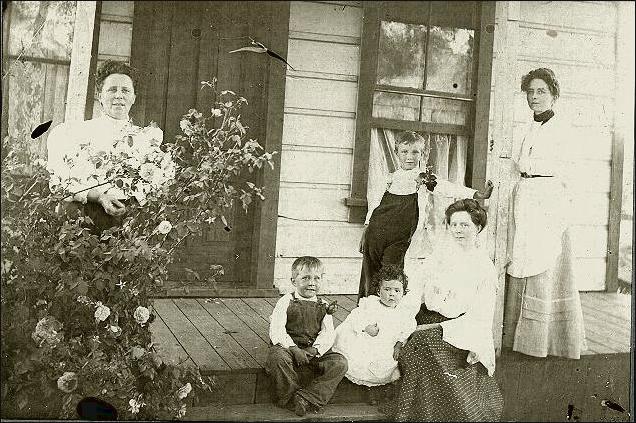
Grandfather, Grandma, baby Earl and
dad.
Then they went back together and moved to
Silver City, New Mexico. There was a big copper mine a ways out that
was going broke. They had your grandfather take over the bankruptcy,
and he re-organized and developed it into a pit mine. It was the
first court case in New Mexico where the mine rallied to pay all
it's debts off. Of all the people involved, there was only one man
who did anything to show appreciation. He was the Chinese man who
gave your grandmother the silk shawl that used to be on the piano.
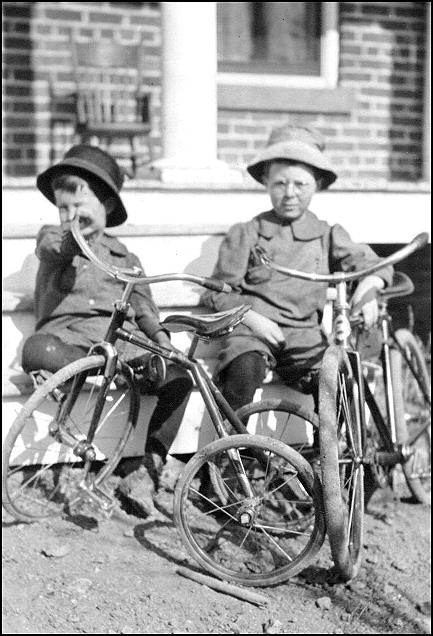
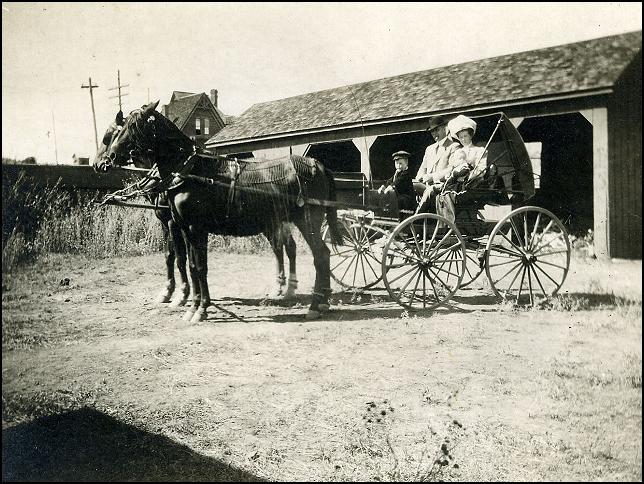
Earl and dad at Silver City, New
Mexico in 1913.
During this period in New Mexico your
grandfather achieved prominence in the mining field. He became
associated with Hoval Smith and a man named Havalin. Hoval Smith
later became the president of the Anaconda Company. He made the
biggest copper mining company in the world. When I was working for
GSA I was talking to one of the mining engineers I mentioned the
name "Hoval" and he said, "Hoval! Say there's only one other
Hoval...the famous mining engineer!"
I said, "Yeah, that's Hoval Smith. My
brother's named after him because he was my father's partner."
He'd heard of my father too. This was during
the 1950's. Hoval Smith was one of the greats in the copper fields.
Havalin was an inventor and Dean of the University of Minnesota. He
was well known in the educational field, and always said that when
your father and I were ready for college we could have free tuition
at his school. The third man of the group was a man named Hitchcock,
who became famous later on as the publisher of the Chicago Sun and
Phoenix Sun, or whatever, in Arizona. He became Postmaster General
under Howard Taft, and initiated the Parcel Post system.
So you
see, we had quite an acquaintanceship at times. It was quite an
exciting life for us youngsters. Although there was one thing....We
could never go to school for very long. We attended from ten to
fifteen schools a year, and it's surprising we knew anything. Now
understand that all these things happened when we were very young,
because our parents separated when your father was thirteen and I
was twelve.
It was very fascinating. Since then I've found
out a lot of things that happened. I was in Phoenix, Arizona about
ten or fifteen years ago with GSA (General Service Administration of
the Federal Government) visiting and looking at the new Customs
building at Nogales. I had to pick up the Superintendent who was
down there from Tucson. On the way back he said he wanted me to see
the new highway between there and New Mexico, so we went up on a
hill near Tucson overlooking it. He said, "That's the General
Hitchcock highway."
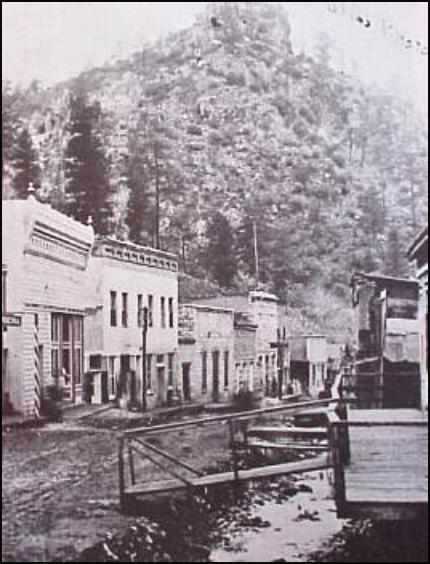
Flooded streets of Mogollon in 1914.
I answered, "That's interesting, because
General Hitchcock and my dad were partners one time." He looked at
me and said, "My God! It can't be! You're one of those little Wayne
kids? My father was a foreman in a
Mogollon (pronounced muggy-own)
mine working for your dad. You were the orneriest little kids around
there. You were just little tykes, and I remember going down and
watching the two of you. Your brother would catch a donkey and make
you hold onto it's ear with your mouth while he got on to ride it.
You were more trouble around there than anything else....I was just
a boy (about ten years older) too young to work in the mine, but I
remember your dad was an immense man. He was a tough customer except
when it came to his family."
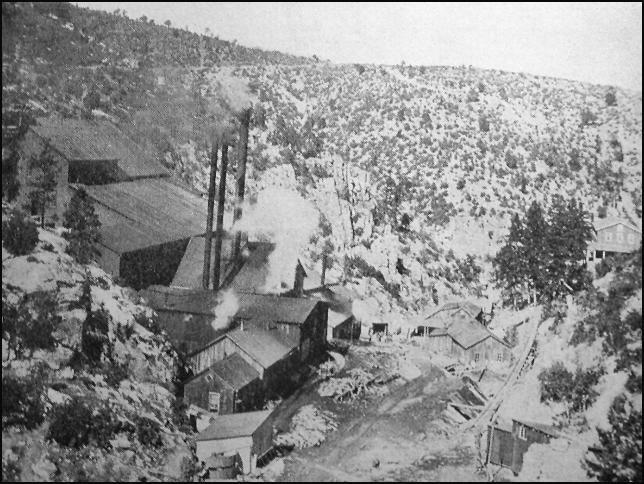
The Last Chance....Ernestine Company
Mill and Mine in Mogollon Mountains.
When we lived in Mogollon, New Mexico the
Ernestine Mine belonged to my father. It was the biggest producing
mine in the state. There were many mines scattered around in this
region. I have a faint recollection of these as a little boy, and it
was confirmed by my mother later....but apparently
Pancho Villa came
across the border and was raiding all the mines to get the gold away
from them. I barely recall seeing all these Mexicans and their
donkeys coming in a big long row. They were coming up the ravine
towards the mine. The people had abandoned the other mines, but my
mother and father hadn't moved because my father said, 'No we're not
going to move. I used to know Pancho Villa and he wont do anything.'
Down at the mine in Cananea he had been their butcher-boy. When
Poncho and his men came up to their house, he recognized my mother's
unusual bright red hair, and my father. They talked at the kitchen
table, renewing an old friendship. Poncho never knew their gold
bullion was hidden under the beds. He and his men left without
taking anything from them, but raided the Maude S. and other mines
in the area. It just goes to show that you never know what doing
good to someone means. It's a small world. Apparently my mother had
done nice things for Pancho and his family.
Our father and mother had many interesting
experiences....like the one of the "Titanic."
We were living in Boston where my father had his office. Among his
associates was a man in England named Sir Hague. They had developed
this mining corporation and Hague was the chief engineer for it.
Hague later became the famous general in World War I. They were all
well-to-do people over there. Havalin, Taft, Roosevelt and the
others had interests in the company too.
Anyway, my father was in England visiting and
discussing plans to go to Africa and develop some mines. The Titanic
was ready to make it's maiden voyage to the United States. Sir Hague
made arrangements for my father to book passage on it. Everyone
wanted on it. Meanwhile, my father was in Liverpool...growing very
homesick, and the Lusitania was ready to sail, so he took it
instead. The day the Titanic sank, our mother took us down to the
office to hear the reports of its sinking, and while we were there
our father walked in.
We were back there because mom had an
operation at the Catholic hospital. Our great Aunt took care of
Hoval and me. Their names were Dougherty. One of the boys was a
monsignor in the Church. We attended the Catholic Church quite
regularly at that time. This young priest eventually became a
Cardinal...Dougherty. But he failed his mission to convert us. Back
at home our grandmother was quite put out that they were trying to
do this.
Grandma Tresise was originally married to a
man named Callister, but before that she lived in Boston, where she
was destined to become a Nun. It was quite the thing to do then, but
she didn't like the idea. She had an Aunt that lived in Virginia
City. This woman's husband was known as Uncle Hubbard. They never
knew what he did for a living, but when he died he left a pistol,
and the story leaked out that he had been a member of the Jesse
James gang. To this day Wilford Callister, in Sacramento, has the
pistol.
Grandmother eventually married Hugh Callister,
who worked in the mines around Virginia City. She had the oldest
daughter, the son Wilford, and was pregnant with my mother when her
husband passed away. His family were prominent people on the Isle of
Man who spent money for grandmother to bring their son home for
burial on the Isle of Man. Old man Callister was a Squire...or Lord.
They had a nice home. When he died he left all his great
grandchildren five guineas. Mom, Agnes Callister Henwood and Will
Callister.
It's interesting that Mom bought a piano with
part of her $500 and gave it to her sister. Then she gave the rest
of it to her brother. She didn't even buy a present for her husband.
That's how the Henwoods had that house up there. She paid for part
of that. It didn't belong to the Henwoods originally. It belonged to
the Callisters (Trezise later on). That was a mistake on her part,
because her husband was supporting the whole family. But that's how
it goes.
Anyway, when grandma returned after burying
her husband, she gave birth to my mother in Virginia City. I believe
she lived with the Gracie family for awhile there. Then she decided
we had to do something to earn a living, so she put up a big tent
and opened a restaurant. She hired twenty Chinese people to work
there. This was the early development of Virginia City, and there
wasn't much there then. Your grandmother was one of the first
children born there.
Eventually she built a two story restaurant
right in town. She did pretty well. Meanwhile, she met a man named
James Trezise who was quite an individual. They called him
"Good-sound Trezise" because he spoke fluent English. The Cousin
Jacks always turned their sentences around, so they named him
Good-sound because he didn't do that. If you heard a real Cornishman
talk you couldn't understand them without living around them to get
the knack. Cornwall was the headquarters for all the pirates of the
world. They were very independent people who were either small or
large built...which was very peculiar. Most in this country are
short fellows.
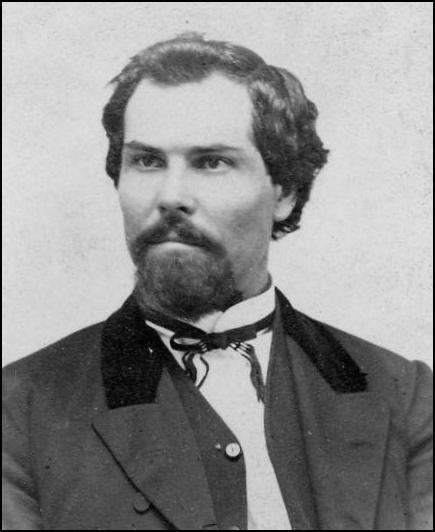
James "Good-sound" Trezise (1865).
Anyway, back to grandma Mary. She decided to
come over here because he was in the mining here. She didn't use
much judgment. She put the three little kids and the dog in a single
horse wagon, and started over the summit. This was in the middle of
November. They were near the Summit House when a blizzard
obliterated the way. They couldn't see anything. The dog led them up
the road to the summit House where they stayed until they could get
out again. They finally reached Grass Valley and settled there. She
married James Trezise. There are some interesting stories about him
that mom told me.
It seems that in Virginia City they were
having a heavy-weight boxing match. In those days they fought bare
fisted. One of the contestants was a man from Australia named Tracy,
or something like that. In those days they trained on whisky and
soaked their hands to make them tough. anyway, they were in the
saloon. Trezise was neatly dressed in a suit and probably looked
like a dude to some. The Australian fighter was buying drinks for
every-one and Trezise didn't drink so he ordered a sasperilla. The
fighter said, 'No...You're going to drink whisky like the rest of
us!' Apparently he took a swing at Trezise, who knocked the man down
so hard he broke his leg, and they had to postpone the fight. I
heard this later on from other sources, so it must have been well
known.
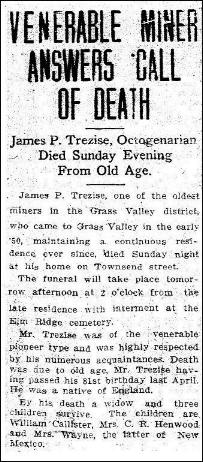
When I lived with him and my grandmother for
awhile on Townsend Street, old man Trezise had a big tub behind the
house. Every morning he'd fill the tub with cold water, strip to the
waist and wash with this water even when there was snow on the
ground. It didn't matter. He did this every day. One day, when he
was around 81, he came in the house and told my grandmother, "Mary,
I'm going to die today."
She said, "No you're not. That's crazy. Why do
you say that?" "Because I couldn't lift my dumbbells very many times
this morning. It's the first time that's ever happened. I'm going to
go lay down in the living room." He went in the other room, lay down
and died. He'd never been sick in his life. Good-sound Trezise was a
nice looking man with a white beard as I remember him when I was a
small boy. He wasn't too tall. A well built man around five foot
ten. (At right is his obituary that was published in the Morning
Union Tuesday, December 23, 1913).
My grandmother was very religious. Quite the
religious student, and I believe a follower of Russell. I'm not sure
about her church, but think she may have belonged to the early
Seventh Day Adventists Church in Grass Valley. She wasn't extreme.
She kept to herself and never forced it on any of us.
My aunt Agnes (Callister Henwood) was a well
versed woman and quite a painter when she was young. She had a great
sense of humor. You never knew what to expect when she was around.
She played baseball with all the kids in the neighborhood. One day
when she was catching, a guy hit a foul ball that caught her in the
eye and gave her the biggest shiner you ever saw. Her husband used
to give her the dickens about being undignified.
You know Bonnie, very few people knew your
father as well as I did. He had kind of a rough life. Everyone told
him he was the oldest, and had to take on the family
responsibilities. This happened when he was around twelve or
thirteen years of age. Things hadn't gone well with our mother and
father who separated, and as a result he had to go out and work when
he was quite young.
We were living in San Jose when our father
went to South America, so Hoval got a job in a box factory. He drew
a full salary for a man's job. From there we moved to Richmond. I
was going to school at the time, and he insisted he had to work. We
didn't have much. Anyway, he went to work for the Pullman company
that made railroad cars. They started him as an apprentice and
shortly made him a blacksmith. He was very strong in the arms.
When he was fourteen we lived in Sacramento
where he went to work for the Pacific Coast Candy Company. Already
he was a carpenter, a blacksmith and now he was making candy. He
became their head chocolate candy maker. It was rough work.
Prior to that we'd lived in Manteca. My father
had bought two tractors. He'd decided to go back to farming. He ran
one and Hoval ran the other tractor. His main job was plowing big
wheat fields around Tracy. In those days they used big tractors that
required half a mile to make a turn. They didn't turn very well.
They'd hired him to plow the corners....and he'd go like a
son-of-a-gun in his Fordson tractor. So Hoval was running the
business, because dad would tire of it and leave to do other things.
Then your dad came to Grass Valley to work in
the mines. He was standing in line when one old Cousin Jack came up
to him and asked, "Say, aren't you Good-sound's grandson?" Your dad
said he was, and the man told him that he didn't have to stand in
line...to go up to the office. Good-sounds family could always work
there. He said that Billy Bourn and Good-sound had originally
prospected over where the North Star Mine was. The foreman told
Hoval that it was a tradition that any direct relative of Good-sound
Tresise had a job at the Empire Mine if they wanted it. Your dad was
around sixteen then. I started work underground about the same time
at the North Star when I was fifteen.
You know Bonnie, your father was an
interesting individual who could always get himself into little
troubles, but could get out of them pretty well. This worried my
mother quite a bit and she used to call me to go find him and see
how he was doing. One time she called me and I went down to Oakland
on Telegraph Avenue where all the engineers hung around. I knew he
went there sometimes, so I walked in and sat down at the front end
of this long bar. There were two men next to me, but got up and
moved to the far end. I couldn't figure this out, until the
bartender came over and said, "How are ya Hats?" Then he looked at
me and corrected himself. I told him Hats was my brother, and asked
if he'd seen him. He mentioned Hats had been in there the night
before and some guy had become loud and boisterous. "Your brother
doesn't like to show off in here, but this guy made some remark to
him or did something, and your brother got up and hit him and
knocked him through the door and broke his leg. Those guys over
there probably thought you were Hats too. All the steel workers know
him and respect him." Everyone called him hats because he always
wore nice hats.
Another interesting story about your dad
happened when he was running a clamshell (crane) on the Feather
River, about 1000-1,500 feet in the air, while working on a railroad
trestle. The whole structure and machinery started to fall, so he
jumped out of the cab and grabbed a piece of steel sticking out at
the end of the bridge and hung on there while everything else fell."
(This is the end of our taped conversation
that wonderful afternoon we spent together talking about the things
I wanted to know about our grandparents, dad and
Uncle Earl. I've always wished
I'd recorded more).
Epilogue
Friday, March 30, 2012 I received an email
from Dave Trezise, who lives in Australia. His wonderful research
breathes new life into our family history. I sent him some photos
that were in James (Good-Sound) Trezise's album that he identified.
Hi Bonnie,
I love your site
and all the history that you have recorded. I am researching James P
Trezise and I am wondering if you have found who his parents were. I
suspect the P stands for Pool. I note that he emigrated to the US in
1854 so he was in Grass Valley quite a while. Is it OK if I use the
information in your Uncle Earl’s story about him for any research I
produce about him. I am a member of the Trezise ONE Name group and
they would be interested if I can find anything about his history.
I have done some work on a man I think is
James’ brother Henry (see attached file).
If I am correct
James was christened 20 May 1832 at St Just in Penwith, his parents
living at Bosworlas, Kelynack, Cornwall. His parents were Henry
Trezise (c.1 Nov 1795.SJ; son of Henry Trezise and Jane Wallis, d 23
Nov 1839 aged 45 from consumption) and Loveday Pool (c.11 Apr
1802.SJ; daughter of Oliver Pool and Mary Hicks, d 15 Nov 1887
Kelynack from fatty degeneration of heart & a fractured fibula).
Loveday was a school teacher.
The indirect evidence for my
suspicions are that James P was born Apr 1832 (US census data 1900)
which is right for the christening date and that census tells us
that he emigrated in 1854 which is the very year that Henry Pool
Trezise from Kelynack emigrated as well. Makes sense for brothers to
emigrate together.
I can finally put the chase to
sleep. I have contacted one of Henry Pool Trezise’s descendants and
she has a copy of the same photo. So the photos you sent belong to
Loveday Trezise nee Pool (mother), Eliza Champion nee Trezise
(sister) and Henry Pool Trezise (brother of James P Trezise). Thank
you for providing the photos in the first place and for all your
kind assistance. I have attached some newspaper articles that will
interest you
PS Any other photos especially ones taken in
England will be gratefully received and I will endeavour to get
people id for you
Best wishes
Dave Trezise
(living in Brisbane, Queensland, Australia)
Top
Back